

Physical AI and Digital Twins: The New Wave in Engineering Design and Manufacturing Simulations
In 2026, artificial intelligence is moving more visibly beyond text assistants, office automation, and data analysis, and into the engineering environment: simulations, manufacturing models, equipment optimization, virtual testing, and maintenance. This is an important shift for industrial companies because it affects not only the way information is managed, but also the way physical systems are designed, validated, and implemented.
Several developments from the beginning of 2026 clearly point in this direction. Siemens and NVIDIA announced an expanded partnership to build an “Industrial AI operating system”, focused on industrial AI, digital twins, AI-native simulations, adaptive manufacturing, and supply chains. Mistral AI announced the acquisition of Emmi AI, a company specializing in Physics AI for industrial engineering. Unilever and Accenture began a large-scale rollout of AI-enabled digital twins across Unilever’s global manufacturing network. The European Commission also positions digital twins among the key tools for the green and digital transition.
For engineering companies and manufacturing enterprises, this is not just a technology update. It is a signal that design, simulation, implementation, and subsequent optimization are gradually coming together into a more intelligent and more connected engineering and manufacturing process.
Why engineering AI is no longer only a software topic
Until recently, many discussions about AI focused on text, images, code, or office productivity. In the industrial context, however, the greatest value often comes from another direction: understanding physical processes, material behavior, motion, heat, airflow, loads, vibrations, and the interaction between mechanics, electronics, control, and the real production environment.
This is where the concept of Physics AI appears. In relation to the acquisition of Emmi AI, Mistral states that the goal is to expand the ability of its models to understand and model physics, as well as to enable AI agents to use existing engineering tools. Emmi AI is described as a company with expertise in large engineering models, real-time simulations, and digital twins for optimizing industrial assets.
In practical terms, this means that AI is gradually starting to support tasks that previously required long simulation cycles, expensive iterations, and significant expert resources. It does not eliminate engineering experience. It amplifies it: instead of waiting for the result of a heavy simulation or testing only a limited number of variants, the engineer can compare scenarios faster, identify risks, and make better-informed decisions.
What “Physics AI” means in an industrial context
In engineering, physical systems cannot be treated only as data. A machine has mass, inertia, friction, thermal expansion, allowable stresses, deformation, clearances, cyclic loading, and a real operating environment. This is why industrial AI must respect physical constraints, not simply recognize statistical patterns.
Physics AI can be viewed as a combination of three elements:
First, physical models and simulations that describe real behavior, for example stresses in a structure, heat transfer, mechanism motion, or airflow.
Second, real operational data: sensors, controllers, production parameters, alarms, cycles, energy consumption, and maintenance data.
Third, AI models that accelerate analysis, identify dependencies, suggest scenarios, and support optimization.
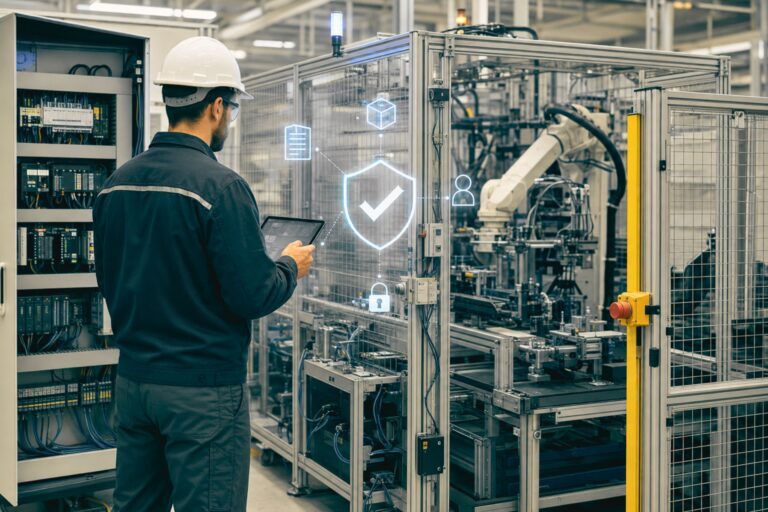
Siemens describes AI-powered digital twins as a combination of physics-based simulation and real-time operational data that creates dynamic representations of products, machines, and entire manufacturing systems. The goal is faster design, validation, and optimization through a continuous connection between the virtual and physical world.
The digital twin is no longer just a 3D model
One common mistake is to understand the digital twin as an attractive 3D visualization. The 3D model is only the beginning. A true digital twin connects geometry, physics, data, control logic, simulations, and real operation.
Siemens defines the comprehensive digital twin as a living digital model of a product, machine, or plant that evolves throughout the entire lifecycle and enables simulation, testing, and optimization before real-world construction. The company emphasizes the ability to run “what-if” scenarios, predict behavior, reduce risk, and make decisions faster.
In engineering practice, this changes the sequence of work. Instead of first manufacturing, installing, and then discovering problems, more checks can be moved into a virtual environment: accessibility, kinematics, loads, collisions, cycles, ergonomics, thermal behavior, control logic, and maintenance.
This is especially important for specialized equipment, non-standard mechanisms, automated cells, and manufacturing systems where every late change can be expensive.
From traditional design to virtual testing
The traditional engineering process often follows this logic: concept, 3D model, manufacturing, assembly, testing, correction. In more complex systems, this can lead to problems being discovered too late: poor maintenance access, insufficient space for movement, unexpected vibrations, unsuitable sequence of operations, low capacity, or the need for mechanical changes after startup.
The digital twin allows part of these risks to be identified earlier. Siemens Digital Twin Composer, presented at CES 2026, is positioned precisely as a tool for building, testing, and optimizing in a virtual environment before physical implementation. According to Siemens, the solution combines 2D and 3D data, real operational data, a high-quality 3D environment, and industrial AI.
In practical terms, this means the engineering team can work with more variants and fewer assumptions. The questions are no longer only “Can we manufacture it?”, but also:
- how will the system behave under different loads;
- what happens if the layout changes;
- where are the potential bottlenecks;
- how will the equipment be serviced;
- what are the risks during real operation;
- which changes are the most economically justified.
What the industrial examples from 2026 show
The developments from 2026 are important because they show that digital twins are no longer only a topic for presentations and pilot laboratories.
Unilever and Accenture announced a partnership to scale AI-enabled digital twins across Unilever’s global manufacturing network. According to the official announcement, digital twins use live data from production systems to monitor and predict how machines and processes are performing. Unilever plans more than 40 new digital twins over the next 18 months.
In a specific manufacturing example provided by Accenture, a digital twin at a Unilever plant in Raeford, North Carolina, predicted 95% of process flow constraints in deodorant stick production, leading to a 20% reduction in waste and a 10% increase in capacity.
Siemens also gives an example with PepsiCo, where Digital Twin Composer is used to simulate and validate configurations of manufacturing and warehouse facilities. According to Siemens, the initial deployment led to a 20% increase in throughput, a 10 to 15% reduction in capital expenditure, and identification of up to 90% of potential issues before physical implementation.
These examples come from large international companies, but the principle is also applicable in smaller industrial environments: the value comes from earlier problem detection, better simulation of alternatives, and a stronger connection between the engineering solution and real operation.
Practical value for manufacturing companies
For most manufacturing companies, the key question is not whether the digital twin sounds modern, but whether it solves a specific problem. Its practical value can appear in several areas.
Fewer physical prototypes and expensive corrections
When variants can be tested virtually, some errors are identified before manufacturing, assembly, or commissioning. This reduces the risk of late changes.
Faster comparison of engineering alternatives
A mechanism, fixture, or workcell can be evaluated across several scenarios: different loads, positions, cycles, constraints, and operating modes.
Better preparation for implementation
Virtual testing supports planning for assembly, access, safety, servicing, and sequence of operations.
Better maintenance management
When real data returns to the digital model, signs of wear, deviations, and future problems can be identified. Siemens notes that digital twins combined with operational data and AI can support continuous optimization and predictive maintenance.
Better communication between teams
The digital model creates a shared basis for discussion between engineering, production, maintenance, management, and the customer. This is especially important in non-standard solutions where many decisions must be validated before physical implementation.
Where this approach is most suitable
Not every task requires a full digital twin. In some cases, a well-prepared 3D model and a basic simulation are sufficient. In other cases, the value of the digital model increases significantly.
The most suitable applications include:
- specialized machines and non-standard equipment;
- automated manufacturing cells;
- systems with motion, kinematics, and collision risk;
- structures with critical loads;
- processes involving thermal, fluid, or vibration dependencies;
- production lines with bottlenecks;
- equipment where downtime is expensive;
- systems that will be optimized after implementation.
In these cases, the digital twin is not just visualization. It is a tool for risk reduction and better engineering decisions.
What must be prepared before creating a digital twin
A digital twin is only as reliable as the data and engineering assumptions behind it. If the geometry is inaccurate, the input parameters are weak, or real operation is poorly understood, the model may create a false sense of confidence.
That is why it is important to clarify the following before starting:
- what problem the model must solve;
- which parameters are critical;
- what data is available;
- which scenarios must be simulated;
- what will be validated virtually and what will be validated on site;
- who will keep the model up to date;
- how the results will be used for real engineering decisions.
HANNOVER MESSE 2026 also emphasizes that the digital twin is evolving from an engineering tool into a central part of industrial management, but this requires integration into organizational, data, and decision-making structures. The same analysis highlights the importance of data model governance, IT/OT integration, and cybersecurity.
How companies can start without making the process unnecessarily complex
For most enterprises, the reasonable starting point is not a large, complex digital twin of an entire plant. It is more appropriate to begin with a specific engineering and manufacturing problem where there is clear value.
A practical approach can look like this:
1. Select a specific problem
For example, frequent corrections after assembly, capacity issues, difficult maintenance, unstable cycle time, collision risk, or expensive changes after implementation.
2. Create a reliable 3D model and technical basis
The model should reflect real geometry, constraints, access, and key operating conditions.
3. Add a simulation layer
Depending on the task, this may be a kinematic simulation, load analysis, thermal analysis, production flow simulation, or virtual layout testing.
4. Validate against reality
The model should be compared with real measurements, operational data, or production experience.
5. Use the results for decisions
The goal is not to create an attractive digital model, but to make better decisions: change the design, optimize the cycle, reduce risk, improve maintenance, or improve planning.
This keeps the approach pragmatic and manageable, without turning it into an overly complex technology project.
What this means for the engineering process
Physical AI and digital twins will not replace engineering experience. But they will change expectations toward the engineering process.
Design will need to be more connected to simulation. Simulation will need to be more connected to real data. Manufacturing will need to feed information back into the engineering model. Maintenance will need to be seen not only as a reaction to problems, but as part of a continuous optimization cycle.
This creates a new engineering logic: moving from one-time design to the lifecycle of a solution that is tested, implemented, monitored, and improved.
For companies developing specialized equipment, automated solutions, and manufacturing systems, this is especially important. Customers will increasingly expect not only drawings and a finished product, but a well-argued engineering solution: why this concept was chosen, which risks were checked, how the system will be maintained, and how it can be optimized after implementation.
Conclusion
Physical AI and digital twins show where industrial engineering is heading in 2026: earlier validation, faster simulation, a stronger connection between the virtual and real world, and better-informed engineering decisions. The greatest value is not in the technology itself, but in the way it reduces risk, shortens iterations, and helps manufacturing companies make better decisions before physical implementation.
For industry, this means a new standard: engineering solutions must not only be well designed, but also pre-validated, adaptable, and prepared for real operation. Companies that start using digital models, simulations, and real data in a pragmatic way will have a stronger foundation for faster implementation, lower risk, and more resilient manufacturing.
If you are planning to develop specialized equipment, an automated production system, or an engineering assessment of a specific manufacturing process, the Bullitt Engineering team can support you with concept development, 3D modeling, production documentation, technical assessment, and implementation tailored to your real operating conditions. Contact us at +359 89 667 0392 or at office@bullitt-engineering.com to discuss the most suitable approach for your production.
Sources used
- Siemens and NVIDIA: expanded partnership for an Industrial AI operating system, industrial AI, physical AI, and digital twins. (press.siemens.com)
- Siemens: Digital Twin Composer, presented at CES 2026, and its application for virtual testing, simulation, and optimization. (press.siemens.com)
- Mistral AI: acquisition of Emmi AI and development of Physics AI for industrial engineering, real-time simulations, and digital twins. (mistral.ai)
- Unilever and Accenture: AI-enabled digital twins in Unilever's global manufacturing network. (unilever.com)
- European Health and Digital Executive Agency: digital twins as a tool for the green and digital transition in Europe. (hadea.ec.europa.eu)
- HANNOVER MESSE 2026: the digital twin as a new foundation for industrial management, integration of AI, simulations, and real-time data. (hannovermesse.de)