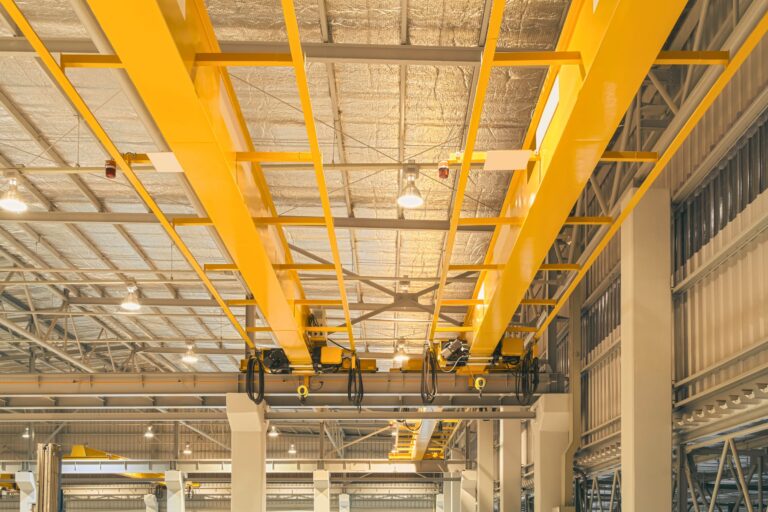



Integration of crane systems with conveyors and AGV/AMR flows
Synchronized operation between overhead/gantry cranes, conveyors and autonomous mobile robots (AGV/AMR) turns internal logistics into a predictable and measurable process. Proper integration reduces machine downtime, shortens routes and minimizes manual transfers and risks.
What does an „integrated“ system mean?
- Single stream: clear handover points between crane-conveyor-AGV/AMR: position, height, direction and ready/busy signals.
- General safety logic: zoning, interlocks, speed limits and slow-approach modes in shared corridors.
- Synchronized beat: buffers and temporary storage for decoupling the clock between sections so that there is no "domino" of delays.
Management architecture
- PLC level (crane/conveyor): hard real time for axes and motion profiles; intermediate signals (Ready, Request, Clamp OK, Weight OK).
- Fleet/AGV controller: mission management, conflict avoidance and zone reservation ("reservation grid").
- MES/WMS/ERP: assignments, priorities, traceability (lot, pallet, ton-meter), buffer and routing rules.
- IIoT/SCADA: common dashboard for statuses, alarms and KPIs; history of cycles and downtimes.
Handover points – good practices
- Mechanical references: fixed „nests“, stops and sensors (inductive/laser) for ± position accuracy.
- Load-grip interface: traverse/vacuum/magnet with grip confirmation; lift lock without „Grip OK“.
- Heights and corridors: predefined heights for safe passage over AGV/conveyor; prohibited areas over people/machines.
- Light/sound signaling: Lines/pictograms on the floor for active corridors; indication of upcoming transmission.
Synchronization and anti-conflict logic
- Zone reservation: before the crane trolley/AGV enters a shared area – request and confirmation from the coordinator.
- Anti-swing + slow-approach: automatic load calming and fine positioning during handover to reduce cycle time.
- Failure algorithm: clear timeouts and scenarios "if the partner does not come" - parking in a buffer, redirection, signal to the dispatcher.
Conveyors and buffers
- Types of conveyors: roller/belt/chain with zoned drive (ZPA) to avoid collisions.
- Buffer stations: „"n+1" locations before/after the crane area for peak smoothing; identification via sensors/scanners.
- Traceability: label/code (QR/RFID) + scales/load cells if needed; automatic matching with the task.
Integration with AGV/AMR
- Navigation and bookmarks: visual, LiDAR natural landmarks or QR/ARU markers; clearly marked pick/drop zones.
- Time windows: missions with SLA; priorities (machine waiting/human waiting) to avoid backlogs.
- Charging and service: planned „holes“ for charging cycles; maintenance routes outside the main corridors.
Safety by design
- PLC Safety and interlocks: dual-channel circuits, laser zone scanners, height/speed limiters, overload control.
- Signal compatibility: common table of statuses and priorities; uniform terminology between providers.
- Evacuation rules: what happens when a subsystem stops – safe positions, evacuation, recovery.
KPI and monitoring
- Handover cycle time and 95th percentile (flow stability).
- Buffer level and average time in queue (WIP).
- Percentage of rejected/retransmission attempts (retries).
- Unplanned downtime by subsystem (crane/conveyor/AGV) and reasons.
- Energy per cycle (kWh/load) as an indirect indicator of smoothness/shocks.
The Bulgarian context: practical notes
- Mixed technologies and different generations of equipment: deploy "translators" (PLC/OPC UA/MQTT gateway) for a common language between systems.
- Limited areas and low clearance heights: plan aisles and hook/load heights with safety and visibility as a priority.
- Support and parts availability: standardized sensors/actuators, clear checklists in Bulgarian, training of 1–2 „super users“.
Implementation plan (phased)
- Flow diagnostics: route maps, bottlenecks, expected speed; definition of handover points.
- Functional specification: a matrix of signals, zones, interlocks, heights/speeds and buffers.
- Pilot line: one crane-conveyor-AGV handover with measurable KPIs; setting up profiles and zones.
- Optimization and standards: uniform recipes/interfaces, KPI dashboards, failure procedures.
- Scaling: adding lines and missions, general charge/support planning, revision of buffers.
Final accent
True integration is not just about connecting signals, but about synchronization of clock, safety and fault logic. When the crane, conveyors and AGV/AMR share the same movement and handover rules, the flow becomes predictable and the cycles are shorter and quieter. The best results come from a phased implementation with clear KPIs, robust interfaces and maintenance discipline.